
Microsoft Todo Mac Github
- Microsoft To Do Mac
- Microsoft To Do Download
- To Do Download
- Microsoft To Do Lists Tasks Reminders
- Microsoft Todo Mac Github Tutorial
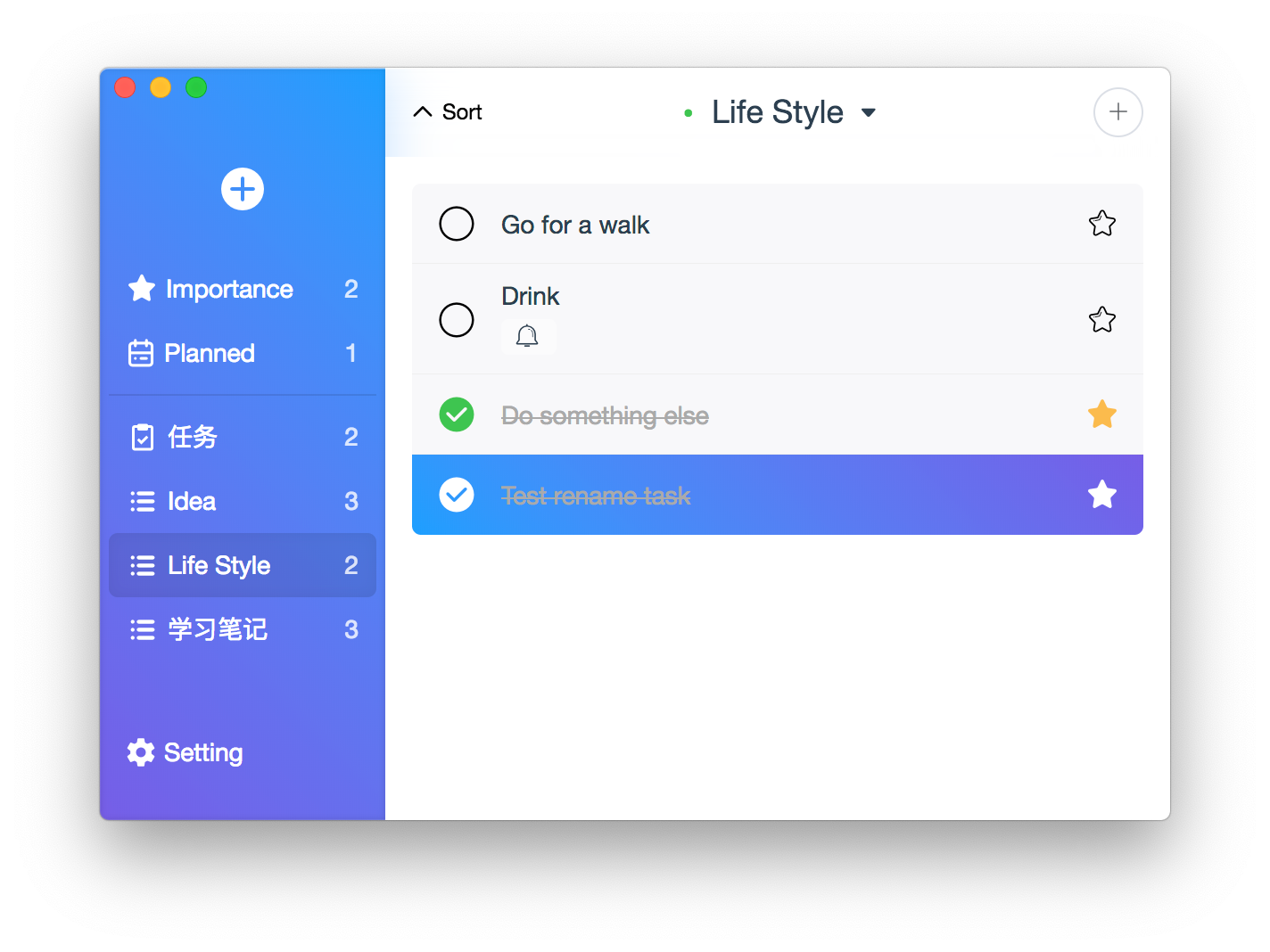
2017-6-7 Microsoft To-Do 是一个轻量和智能的待办清单去帮助您更轻松地计划每一天。两年前,微软收购了 Wunderlist,而前前前些时间,他们交出了 Microsoft To-Do 这份答卷,现在让我们一起来来看看安卓顶尖开发商微软公司. 2019-3-31 woolson/microsoft-todo-mac github.com 最后 做这个软件还是花了些时间的,如果喜欢的话点个Star或者使用提些问题和建议吧。谢谢。相关推荐 图吧(macOS:图床+图片压缩+图片裁切). 2016-11-4 使用任务列表 Use the Task List 本文内容 使用“任务列表” 跟踪使用 TODO 和 HACK 或自定义令牌等令牌的代码注释,还能管理直接导向代码中的预定义位置的快捷方式。Use Task List to track code comments that use tokens such as TODO and HACK, or custom tokens, and to manage shortcuts that take you directly to a predefined location in. 2019-10-25 Ao is an unofficial, featureful, open source, community-driven, free Microsoft To-Do app, used by people in more than 120 countries. Read this document in: Deutsch. You can now support the development process through GitHub Sponsors.
Microsoft To Do Mac
- GitHub is home to over 40 million developers working together to host and review code, manage projects, and build software together. Sign up Unofficial Microsoft ToDo app for MacOS.
- 2019-5-20 Uninstall Office 2016 from OS X completely. GitHub Gist: instantly share code, notes, and snippets.
- Creating a remote repo on GitHub. The following example uses a GitHub host, but you can use any Git host for version control in Visual Studio for Mac. To set up a Git repository, execute the following steps: Create a new Git repo at github.com: Set Repo Name, description, and privacy. Do not initialize Repo. Set.gitignore and license to None.
Azure Cosmos DB is Microsoft's globally distributed multi-model database service. You can quickly create and query document, key/value, and graph databases, all of which benefit from the global distribution and horizontal scale capabilities at the core of Azure Cosmos DB.
Note
Sample code for an entire canonical sample Xamarin app showcasing multiple Azure offerings, including CosmosDB, can be found on GitHub here. This app demonstrates viewing geographically dispersed contacts, and allowing those contacts to update their location.
This quickstart demonstrates how to create an Azure Cosmos DB SQL API account, document database, and container using the Azure portal. You'll then build and deploy a todo list mobile app built on the SQL .NET API and Xamarin utilizing Xamarin.Forms and the MVVM architectural pattern.
Prerequisites
If you are developing on Windows and don't already have Visual Studio 2019 installed, you can download and use the freeVisual Studio 2019 Community Edition. Make sure that you enable Azure development and Mobile Development with .NET workloads during the Visual Studio setup.
If you are using a Mac, you can download the freeVisual Studio for Mac.

If you don't have an Azure subscription, create a free account before you begin.
You can Try Azure Cosmos DB for free without an Azure subscription, free of charge and commitments, or create an Azure Cosmos DB free tier account, with the first 400 RU/s and 5 GB of storage for free. You can also use the Azure Cosmos DB Emulator with a URI of https://localhost:8081. For the key to use with the emulator, see Authenticating requests.
Create a database account
Go to the Azure portal to create an Azure Cosmos DB account. Search for and select Azure Cosmos DB.
Select Add.
On the Create Azure Cosmos DB Account page, enter the basic settings for the new Azure Cosmos account.
Setting Value Description Subscription Subscription name Select the Azure subscription that you want to use for this Azure Cosmos account. Resource Group Resource group name Select a resource group, or select Create new, then enter a unique name for the new resource group. Account Name A unique name Enter a name to identify your Azure Cosmos account. Because documents.azure.com is appended to the name that you provide to create your URI, use a unique name.
The name can only contain lowercase letters, numbers, and the hyphen (-) character. It must be between 3-31 characters in length.API The type of account to create Select Core (SQL) to create a document database and query by using SQL syntax.
The API determines the type of account to create. Azure Cosmos DB provides five APIs: Core (SQL) and MongoDB for document data, Gremlin for graph data, Azure Table, and Cassandra. Currently, you must create a separate account for each API.
Learn more about the SQL API.Apply Free Tier Discount Apply or Do not apply With Azure Cosmos DB free tier, you will get the first 400 RU/s and 5 GB of storage for free in an account. Learn more about free tier. Location The region closest to your users Select a geographic location to host your Azure Cosmos DB account. Use the location that is closest to your users to give them the fastest access to the data. Account Type Production or Non-Production Select Production if the account will be used for a production workload. Select Non-Production if the account will be used for non-production, e.g. development, testing, QA, or staging. This is an Azure resource tag setting that tunes the Portal experience but does not affect the underlying Azure Cosmos DB account. You can change this value anytime.
Note
You can have up to one free tier Azure Cosmos DB account per Azure subscription and must opt-in when creating the account. If you do not see the option to apply the free tier discount, this means another account in the subscription has already been enabled with free tier.
Select Review + create. You can skip the Network and Tags sections.
Review the account settings, and then select Create. It takes a few minutes to create the account. Wait for the portal page to display Your deployment is complete.
Select Go to resource to go to the Azure Cosmos DB account page.
Add a container
You can now use the Data Explorer tool in the Azure portal to create a database and container.
Select Data Explorer > New Container.
The Add Container area is displayed on the far right, you may need to scroll right to see it.
In the Add container page, enter the settings for the new container.
Setting Suggested value Description Database ID Tasks Enter Tasks as the name for the new database. Database names must contain from 1 through 255 characters, and they cannot contain /, , #, ?, or a trailing space. Check the Provision database throughput option, it allows you to share the throughput provisioned to the database across all the containers within the database. This option also helps with cost savings.Throughput 400 Leave the throughput at 400 request units per second (RU/s). If you want to reduce latency, you can scale up the throughput later. Container ID Items Enter Items as the name for your new container. Container IDs have the same character requirements as database names. Partition key /category The sample described in this article uses /category as the partition key. In addition to the preceding settings, you can optionally add Unique keys for the container. Let's leave the field empty in this example. Unique keys provide developers with the ability to add a layer of data integrity to the database. By creating a unique key policy while creating a container, you ensure the uniqueness of one or more values per partition key. To learn more, refer to the Unique keys in Azure Cosmos DB article.
Select OK. The Data Explorer displays the new database and container.
Add sample data
You can now add data to your new container using Data Explorer.
From the Data Explorer, expand the Tasks database, expand the Items container. Select Items, and then select New Item.
Now add a document to the container with the following structure.
Once you've added the json to the Documents tab, select Save.
Create and save one more document where you insert a unique value for the
idproperty, and change the other properties as you see fit. Your new documents can have any structure you want as Azure Cosmos DB doesn't impose any schema on your data.
Query your data
You can use queries in Data Explorer to retrieve and filter your data.
At the top of the Items tab in Data Explorer, review the default query
SELECT * FROM c. This query retrieves and displays all documents from the container ordered by ID.To change the query, select Edit Filter, replace the default query with
ORDER BY c._ts DESC, and then select Apply Filter.The modified query displays the documents in descending order based on their time stamp, so now your second document is listed first.
If you're familiar with SQL syntax, you can enter any supported SQL queries in the query predicate box. You can also use Data Explorer to create stored procedures, UDFs, and triggers for server-side business logic.
Data Explorer provides easy Azure portal access to all of the built-in programmatic data access features available in the APIs. You also use the portal to scale throughput, get keys and connection strings, and review metrics and SLAs for your Azure Cosmos DB account.
Clone the sample application
Now let's clone the Xamarin SQL API app from GitHub, review the code, obtain the API keys, and run it. You'll see how easy it is to work with data programmatically.
Open a command prompt, create a new folder named git-samples, then close the command prompt.
Open a git terminal window, such as git bash, and use the
cdcommand to change to the new folder to install the sample app.See below for security related patches released Between 07/01/15 and 07/31/15Please note: Not all of these patches will be applicable to every machine, but all are included for informational purposes. Microsoft office 2011 for mac update 14.5.3 pc.
Run the following command to clone the sample repository. This command creates a copy of the sample app on your computer.
Then open the ToDoItems.sln file from the samples/xamarin/ToDoItems folder in Visual Studio.
Obtain your API keys
Go back to the Azure portal to get your API key information and copy it into the app.
In the Azure portal, in your Azure Cosmos DB SQL API account, in the left navigation click Keys, and then click Read-write Keys. You'll use the copy buttons on the right side of the screen to copy the URI and Primary Key into the APIKeys.cs file in the next step.
In either Visual Studio 2019 or Visual Studio for Mac, open the APIKeys.cs file in the azure-cosmos-db-sql-xamarin-getting-started/src/ToDoItems.Core/Helpers folder.
Copy your URI value from the portal (using the copy button) and make it the value of the
CosmosEndpointUrlvariable in APIKeys.cs.public static readonly string CosmosEndpointUrl = ';Then copy your PRIMARY KEY value from the portal and make it the value of the
Cosmos Auth Keyin APIKeys.cs.public static readonly string CosmosAuthKey = ';
Important
This quick start hard codes the Azure Cosmos DB authentication key for the sake of demonstration purposes. It's not recommended to hard code an authentication key when you are using it in a production app. To learn how to access Azure Cosmos DB in a securely by using a resource token, view the Authenticating users with Azure Cosmos DB article.
Review the code
This solution demonstrates how to create a ToDo app using the Azure Cosmos DB SQL API and Xamarin.Forms. The app has two tabs, the first tab contains a list view showing todo items that are not yet complete. The second tab displays todo items that have been completed. In addition to viewing not completed todo items in the first tab, you can also add new todo items, edit existing ones, and mark items as completed.
The code in the ToDoItems solution contains:
- ToDoItems.Core: This is a .NET Standard project holding a Xamarin.Forms project and shared application logic code that maintains todo items within Azure Cosmos DB.
- ToDoItems.Android: This project contains the Android app.
- ToDoItems.iOS: This project contains the iOS app.
Now let's take a quick review of how the app communicates with Azure Cosmos DB.
The Microsoft.Azure.DocumentDb.Core NuGet package is required to be added to all projects.
The
ToDoItemclass in the azure-documentdb-dotnet/samples/xamarin/ToDoItems/ToDoItems.Core/Models folder models the documents in the Items container created above. Note that property naming is case-sensitive.The
CosmosDBServiceclass in the azure-documentdb-dotnet/samples/xamarin/ToDoItems/ToDoItems.Core/Services folder encapsulates the communication to Azure Cosmos DB.Within the
CosmosDBServiceclass there is aDocumentClienttype variable. TheDocumentClientis used to configure and execute requests against the Azure Cosmos DB account, and is instantiated:When querying a container for documents, the
DocumentClient.CreateDocumentQuery<T>method is used, as seen here in theCosmosDBService.GetToDoItemsfunction:The
CreateDocumentQuery<T>takes a URI that points to the container created in the previous section. And you are also able to specify LINQ operators such as aWhereclause. In this case only todo items that are not completed are returned.The
CreateDocumentQuery<T>function is executed synchronously, and returns anIQueryable<T>. However, theAsDocumentQuerymethod converts theIQueryable<T>to anIDocumentQuery<T>object which can be executed asynchronously. Thus not blocking the UI thread for mobile applications.The
IDocumentQuery<T>.ExecuteNextAsync<T>function retrieves the page of results from Azure Cosmos DB, whichHasMoreResultschecking to see if additional results remain to be returned.
Tip
Several functions that operate on Azure Cosmos containers and documents take an URI as a parameter which specifies the address of the container or document. This URI is constructed using the URIFactory class. URIs for databases, containers, and documents can all be created with this class.
The
ComsmosDBService.InsertToDoItemfunction demonstrates how to insert a new document:The item URI is specified as well as the item to be inserted.
The
CosmosDBService.UpdateToDoItemfunction demonstrates how to replace an existing document with a new one:Here a new URI is needed to uniquely identify the document to replace and is obtained by using
UriFactory.CreateDocumentUriand passing it the database and container names and the ID of the document.The
DocumentClient.ReplaceDocumentAsyncreplaces the document identified by the URI with the one specified as a parameter.Deleting an item is demonstrated with the
CosmosDBService.DeleteToDoItemfunction:Again note the unique document URI being created and passed to the
DocumentClient.DeleteDocumentAsyncfunction.
Run the app
You've now updated your app with all the info it needs to communicate with Azure Cosmos DB.
The following steps will demonstrate how to run the app using the Visual Studio for Mac debugger.
Note
Usage of the Android version app is exactly the same, any differences will be called out in the steps below. If you wish to debug with Visual Studio on Windows, documentation todo so can be found for iOS here and Android here.
First select the platform you wish to target by clicking on the dropdown highlighted and selecting either ToDoItems.iOS for iOS or ToDoItems.Android for Android.
To start debugging the app, either press cmd+Enter or click the play button.
When the iOS simulator or Android emulator finishes launching, the app will display 2 tabs at the bottom of the screen for iOS and the top of the screen for Android. The first shows todo items which are not completed, the second shows todo items which are completed.
To complete a todo item on iOS, slide it to the left > tap on the Complete button. To complete a todo item on Android, long press the item > then tap on the complete button.
To edit a todo item > tap on the item > a new screen appears letting you enter new values. Tapping the save button will persist the changes to Azure Cosmos DB.
To add a todo item > tap on the Add button on the upper right of the home screen > a new, blank, edit page will appear.
Review SLAs in the Azure portal
The Azure portal monitors your Cosmos DB account throughput, storage, availability, latency, and consistency. Charts for metrics associated with an Azure Cosmos DB Service Level Agreement (SLA) show the SLA value compared to actual performance. This suite of metrics makes monitoring your SLAs transparent.
To review metrics and SLAs:
Select Metrics in your Cosmos DB account's navigation menu.
Select a tab such as Latency, and select a timeframe on the right. Compare the Actual and SLA lines on the charts.
Review the metrics on the other tabs.
Clean up resources
When you're done with your app and Azure Cosmos DB account, you can delete the Azure resources you created so you don't incur more charges. To delete the resources:
In the Azure portal Search bar, search for and select Resource groups.
From the list, select the resource group you created for this quickstart.
On the resource group Overview page, select Delete resource group.
In the next window, enter the name of the resource group to delete, and then select Delete.
Next steps
In this quickstart, you've learned how to create an Azure Cosmos account, create a container using the Data Explorer, and build and deploy a Xamarin app. You can now import additional data to your Azure Cosmos account.
-->
Git is a distributed version control system that allows teams to work on the same documents simultaneously. This means there is a single server that contains all the files, but whenever a repository is checked out from this central source, the entire repository is cloned locally to your machine.
There are many remote hosts that allow you to work with Git for version control, however the most common host is GitHub. The following example uses a GitHub host, but you can use any Git host for version control in Visual Studio for Mac.
If you wish to use GitHub, make sure that you have an account created and configured before following the steps in this article.
Creating a remote repo on GitHub
The following example uses a GitHub host, but you can use any Git host for version control in Visual Studio for Mac.
To set up a Git repository, execute the following steps:
Create a new Git repo at github.com:
Set Repo Name, description, and privacy. Do not initialize Repo. Set .gitignore and license to None:
The next page gives you an option to display and copy either the HTTPS or SSH address to the repo you have created:
You'll need the HTTPS address to point Visual Studio for Mac to this repo.
Publishing an existing project
If you have an existing project that is not already in version control, use the following steps to set it up in Git:
Select the Solution name from the Solution Pad in Visual Studio for Mac.
In the Menu bar, select Version Control > Publish in Version Control to display the Select Repository dialog:
If this menu item appears greyed out in the menu, make sure you have selected the Solution name.
Choose the Registered Repositories tab and press the Add button:
Enter the name of the repository as you would like it to display locally, and paste in the URL from step #3. Your Repository Configuration dialog should look similar to the following. Press OK:
Please tell me what to do and if you need more information to help solve this issue. Microsoft errir reporting mac wont close.
It is also possible to use SSH to connect to Git.
To attempt to publish the app to Git, select the repository, and ensure that both Module Name and Message text fields are completed:
Click Okay, and then Publish from the alert dialog.
In the Git Credentials window, enter your GitHub username and password.
Note
If your account has two-factor authentication (2FA) enabled, you will need to create an Access Token, which is used in place of a password. If you have not created an access token, follow the steps in the Git Access Token documentation.
Enter the username and Personal Access Token, and press Okay:
After a few seconds, the Solution should be published with its initial commit. Confirm it has been published by browsing the Version Control menu item, which should now be populated with many options:
Once you start to make additional changes, select Push Changes to push the changes to the remote repository. This will allow all appropriate users to view it on github.com:
Publishing a new project
The new project dialog can be used to create a new project with a local git repository. To enable it, select the Use git for version control checkbox, as illustrated in the following screenshot. This will initialize your repo and add an optional .gitignore file:
Follow the steps below to push your new local repository to a new GitHub repository:
Note
If you have not already created a GitHub repository, refer to the Creating a remote repo on GitHub section.
Create your first commit by going to Version Control > Review Solution and Commit in the Menu Bar.
In the Status tab, choose Commit in the top left.
Write a commit message, for example 'First Commit', then click on Commit:
Next, in the Menu Bar go to Version Control > Manage Branches and Remotes.
Go to the Remote Sources tab, then click Add.
In the Remote Source window, add the details of your previously created GitHub repository and click OK:
Close the Git Repository Configuration window, then in the Menu Bar go to Version Control > Push Changes.
In the Push to Repository window click on the Push Changes button:
When prompted, enter your GitHub username and password.
Note
If your account has two-factor authentication (2FA) enabled, you will need to create an Access Token, which is used in place of a password. If you have not created an access token, follow the steps in the Git Access Token documentation.
Visual Studio for Mac will now push the changes to your remote GitHub repository:
Check out an existing repository
It's likely that you'll have to work with a GitHub repo that exists only on the remote, not on your local machine. Visual Studio for Mac allows you to check this repo out quickly. Follow the steps below to clone it to your machine:
In the Menu bar, select Version Control > Checkout:
This displays the Connect to Repository tab:
On the GitHub page of the remote repository, press the Clone or Download button and copy the URL provided:
Replace all the text in the URL entry field in the Connect to Repository tab. This will populate most other fields in this tab for you, as illustrated in the image in step #2.
Enter the directory that you want to clone the repo into and press Checkout.
Note
You may experience issues if the repo is over 4 GB in size.
Microsoft To Do Download
Troubleshooting
To Do Download
If you have issues with initializing your project with an empty remote repository, you can try the following steps:
Microsoft To Do Lists Tasks Reminders
- Go to your solution folder.
- Press Command + Shift + . to show the hidden files and folders.
- If there's a .git folder, delete it.
- If there's a gitignore file, delete it.
- Press Command + Shift + . to hide the files and folders.
- Open your solution in VS for Mac.
- On the solution Pad, select your solution node.
- Browse to the Version Control menu and choose Publish in Version Control.
- Follow the steps of the above tutorial starting from the step 6.